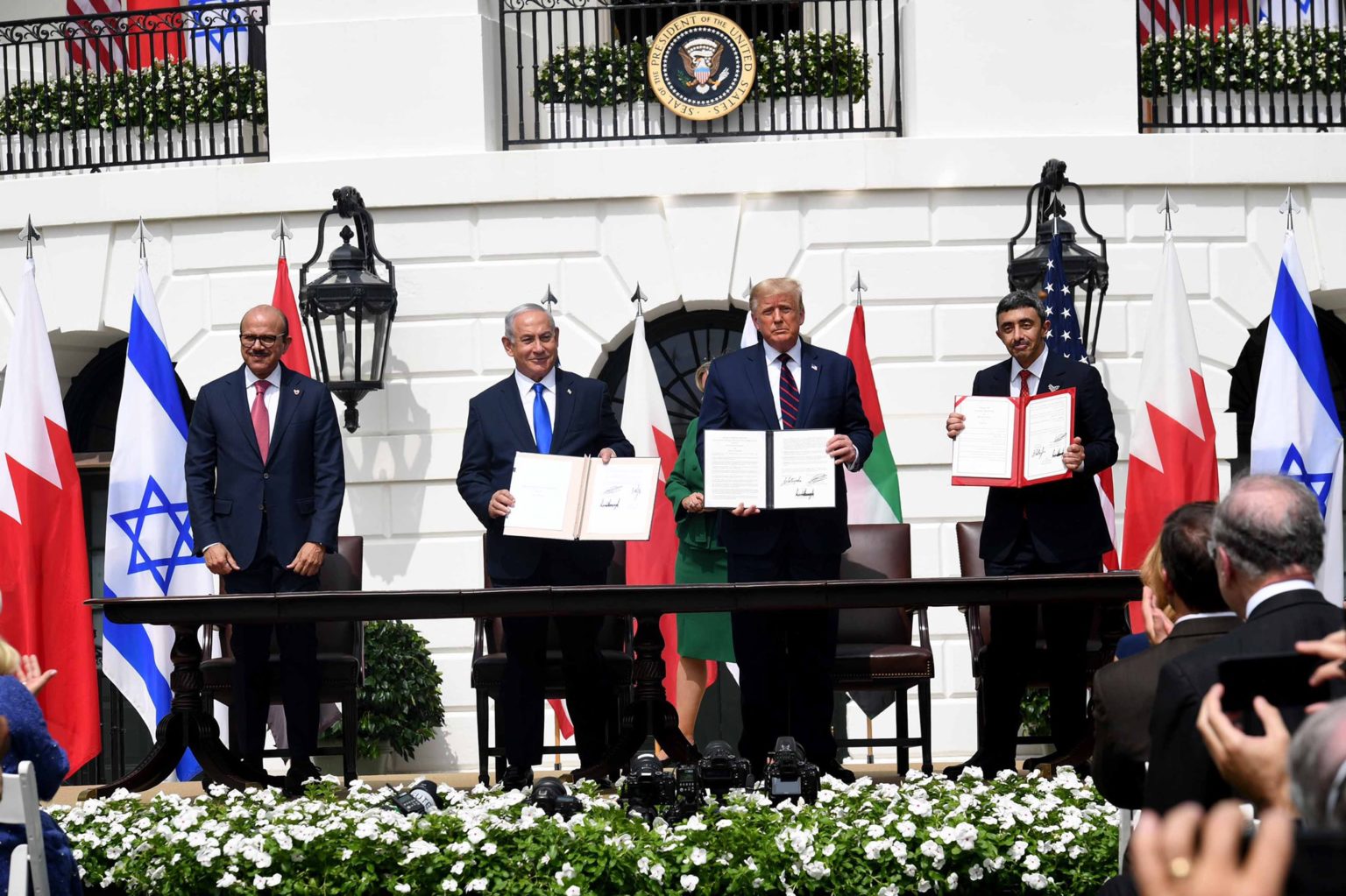
Her følger teksten i fredsavtalene undertegnet mellom Israel og De forente arabiske emirater og Bahrain i Washington D.C. tirsdag 15. september 2020.
Tre dokumenter ble signert:
- En erklæring som alle fire land undertegnet om Abraham-avtalene
- Avtale om fred, diplomatiske forbindelser og full normalsering mellom De forente arabiske emirater og Israel
- Erklæring om fred, samarbeid og konstruktivt diplomatisk og vennskapelig relasjoner mellom kongedømmet Bahrain og Israel
Her følger full tekst på engelsk.
The Abraham
Accords Declaration
We, the
undersigned, recognize the importance of maintaining and strengthening peace in
the Middle East and around the world based on mutual understanding and
coexistence, as well as respect for human dignity and freedom, including
religious freedom.
We encourage efforts to promote interfaith and intercultural dialogue to advance a culture of peace among the three Abrahamic religions and all humanity.
We believe
that the best way to address challenges is through cooperation and dialogue and
that developing friendly relations among States advances the interests of
lasting peace in the Middle East and around the world.
We seek
tolerance and respect for every person in order to make this world a place
where all can enjoy a life of dignity and hope, no matter their race, faith or
ethnicity.
We support
science, art, medicine, and commerce to inspire humankind, maximize human
potential and bring nations closer together.
We seek to
end radicalization and conflict to provide all children a better future.
We pursue a
vision of peace, security and prosperity in the Middle East and around the
world.
In this
spirit, we warmly welcome and are encouraged by the progress already made in
establishing diplomatic relations between Israel and its neighbors in the
region under the principles of the Abraham Accords.
We are encouraged by the ongoing efforts to consolidate and expand such friendly relations based on shared interests and a shared commitment to a better future.
—
Abraham Accords
Peace Agreement: Treaty of Peace, Diplomatic Relations and Full Normalization
Between the United Arab Emirates and the State of Israel
The
Government of the United Arab Emirates and the Government of the State of
Israel (hereinafter, the “Parties”)
Aspiring to
realize the vision of a Middle East region that is stable, peaceful and
prosperous, for the benefit of all States and peoples in the region;
Desiring to
establish peace, diplomatic and friendly relations, co-operation and full
normalization of ties between them and their peoples, in accordance with this
Treaty, and to chart together a new path to unlock the vast potential of their
countries and of the region;
Reaffirming
the “Joint Statement of the United States, the State of Israel, and the United
Arab Emirates” (the “Abraham Accords”), dated 13 August 2020;
Believing
that the further development of friendly relations meets the interests of
lasting peace in the Middle East and that challenges can only be effectively
addressed by cooperation and not by conflict;
Determined
to ensure lasting peace, stability, security and prosperity for both their
States and to develop and enhance their dynamic and innovative economies;
Reaffirming
their shared commitment to normalize relations and promote stability through
diplomatic engagement, increased economic cooperation and other close
coordination;
Reaffirming
also their shared belief that the establishment of peace and full normalization
between them can help transform the Middle East by spurring economic growth,
enhancing technological innovation and forging closer people-to-people
relations;
Recognizing
that the Arab and Jewish peoples are descendants of a common ancestor, Abraham,
and inspired, in that spirit, to foster in the Middle East a reality in which
Muslims, Jews, Christians and peoples of all faiths, denominations, beliefs and
nationalities live in, and are committed to, a spirit of coexistence, mutual
understanding and mutual respect;
Recalling
the reception held on January 28, 2020, at which President Trump presented his
Vision for Peace, and committing to continuing their efforts to achieve a just,
comprehensive, realistic and enduring solution to the Israeli-Palestinian
conflict;
Recalling
the Treaties of Peace between the State of Israel and the Arab Republic of
Egypt and between the State of Israel and the Hashemite Kingdom of Jordan, and
committed to working together to realize a negotiated solution to the Israeli-Palestinian
conflict that meets the legitimate needs and aspirations of both peoples, and
to advance comprehensive Middle East peace, stability and prosperity;
Emphasizing
the belief that the normalization of Israeli and Emirati relations is in the interest
of both peoples and contributes to the cause of peace in the Middle East and
the world;
Expressing
deep appreciation to the United States for its profound contribution to this
historic achievement;
Have agreed
as follows:
1. Establishment of Peace, Diplomatic Relations and Normalization:
Peace,
diplomatic relations and full normalization of bilateral ties are hereby
established between the United Arab Emirates and the State of Israel.
2. General Principles:
The Parties
shall be guided in their relations by the provisions of the Charter of the
United Nations and the principles of international law governing relations
among States. In particular, they shall recognize and respect each other’s
sovereignty and right to live in peace and security, develop friendly relations
of cooperation between them and their peoples, and settle all disputes between
them by peaceful means.
3. Establishment of Embassies:
The Parties
shall exchange resident ambassadors as soon as practicable after the signing of
this Treaty, and shall conduct diplomatic and consular relations in accordance
with the applicable rules of international law.
4. Peace and Stability:
The Parties
shall attach profound importance to mutual understanding, cooperation and
coordination between them in the spheres of peace and stability, as a
fundamental pillar of their relations and as a means for enhancing those
spheres in the Middle East as a whole. They undertake to take the necessary
steps to prevent any terrorist or hostile activities against each other on or from
their respective territories, as well as deny any support for such activities
abroad or allowing such support on or from their respective territories.
Recognizing the new era of peace and friendly relations between them, as well
as the centrality of stability to the well-being of their respective peoples
and of the region, the Parties undertake to consider and discuss these matters
regularly, and to conclude detailed agreements and arrangements on coordination
and cooperation.
5. Cooperation and Agreements in Other Spheres:
As an
integral part of their commitment to peace, prosperity, diplomatic and friendly
relations, cooperation and full normalization, the Parties shall work to
advance the cause of peace, stability and prosperity throughout the Middle
East, and to unlock the great potential of their countries and of the region.
For such purposes, the Parties shall conclude bilateral agreements in the
following spheres at the earliest practicable date, as well as in other spheres
of mutual interest as may be agreed:- Finance and Investment- Civil Aviation-
Visas and Consular Services- Innovation, Trade and Economic Relations
–
Healthcare
– Science,
Technology and Peaceful Uses of Outer-Space
– Tourism,
Culture and Sport
– Energy
–
Environment
– Education
– Maritime
Arrangements
–
Telecommunications and Post
–
Agriculture and Food Security
– Water
– Legal
Cooperation
Any such
agreements concluded before the entry into force of this Treaty shall enter
into effect with the entry into force of this Treaty unless otherwise
stipulated therein. Agreed principles for cooperation in specific spheres are
annexed to this Treaty and form an integral part thereof.
6. Mutual Understanding and Co-existence:
The Parties
undertake to foster mutual understanding, respect, co-existence and a culture
of peace between their societies in the spirit of their common ancestor,
Abraham, and the new era of peace and friendly relations ushered in by this
Treaty, including by cultivating people-to-people programs, interfaith dialogue
and cultural, academic, youth, scientific, and other exchanges between their
peoples. They shall conclude and implement the necessary visa and consular
services agreements and arrangements so as to facilitate efficient and secure
travel for their respective nationals to the territory of each other. The
Parties shall work together to counter extremism, which promotes hatred and
division, and terrorism and its justifications, including by preventing
radicalization and recruitment and by combating incitement and discrimination.
They shall work towards establishing a High-Level Joint Forum for Peace and
Co-Existence dedicated to advancing these goals.
7. Strategic Agenda for the Middle East:
Further to
the Abraham Accords, the Parties stand ready to join with the United States to
develop and launch a “Strategic Agenda for the Middle East” in order to expand
regional diplomatic, trade, stability and other cooperation. They are committed
to work together, and with the United States and others, as appropriate, in
order to advance the cause of peace, stability and prosperity in the relations
between them and for the Middle East as a whole, including by seeking to
advance regional security and stability; pursue regional economic
opportunities; promote a culture of peace across the region; and consider joint
aid and development programs.
8. Other Rights and Obligations:
This Treaty
does not affect and shall not be interpreted as affecting, in any way, the
rights and obligations of the Parties under the Charter of the United Nations.
The Parties shall take all necessary measures for the application in their
bilateral relations of the provisions of the multilateral conventions of which
they are both parties, including the submission of appropriate notification to
the depositaries of such conventions.
9. Respect for Obligations:
The Parties
undertake to fulfill in good faith their obligations under this Treaty, without
regard to action or inaction of any other party and independently of any
instrument inconsistent with this Treaty. For the purposes of this paragraph
each Party represents to the other that in its opinion and interpretation there
is no inconsistency between their existing treaty obligations and this Treaty.
The Parties undertake not to enter into any obligation in conflict with this
Treaty. Subject to Article 103 of the Charter of the United Nations, in the
event of a conflict between the obligations of the Parties under the present
Treaty and any of their other obligations, the obligations under this Treaty
shall be binding and implemented. The Parties further undertake to adopt any
legislation or other internal legal procedure necessary in order to implement
this Treaty, and to repeal any national legislation or official publications
inconsistent with this Treaty.
10. Ratification and Entry into Force:
This Treaty
shall be ratified by both Parties as soon as practicable in conformity with
their respective national procedures and will enter into force following the
exchange of instruments of ratification.
11. Settlement of Disputes:
Disputes
arising out of the application or interpretation of this Treaty shall be
resolved by negotiation. Any such dispute which cannot be settled by
negotiation may be referred to conciliation or arbitration subject to the
agreement of the Parties.
12. Registration:
This Treaty
shall be transmitted to the Secretary-General of the United Nations for
registration in accordance with the provisions of Article 102 of the Charter of
the United Nations.
Done at
Washington, DC, this day Elul 26th, 5780, Muharram 27th, 1442, which
corresponds to 15 September 2020, in the Hebrew, Arabic and English languages,
all texts being equally authentic. In case of divergence of interpretation, the
English text shall prevail.
For the
State of Israel: H.E. Benjamin, Netanyahu, Prime Minister
For the
United Arab Emirates: H.H. Abdullah bin Zayed Al Nahyan, Minister of Foreign
Affairs and International Cooperation
Witnessed
by: H.E. Donald J. Trump, President of the United States of America
ANNEX
Pursuant to
Article 5 of the Treaty of Peace, Diplomatic Relations and Full Normalization
between the United Arab Emirates and the State of Israel, the Parties shall
conclude bilateral agreements in spheres of mutual interest, in furtherance of
which they have agreed to the following provisions. Such provisions are annexed
to the Treaty and form an integral part thereof.
Finance and Investment
Further to
the Agreed Protocol signed between the Parties on September 1, 2020, in Abu
Dhabi, the Parties shall cooperate to expeditiously deepen and broaden
bilateral investment relations, and give high priority to concluding agreements
in the sphere of finance and investment, recognizing the key role of these
agreements in the economic development of the Parties and the Middle East as a
whole. The Parties reaffirm their commitment to protecting investors,
consumers, market integrity and financial stability, as well as maintaining all
applicable regulatory standards. Recognizing also their shared goal to advance
regional economic development and the flow of goods and services, the Parties
shall endeavor to promote collaborations on strategic regional infrastructure
projects and shall explore the establishment of a multilateral working group
for the “Tracks for Regional Peace” project.
Civil Aviation
The Parties
acknowledge the importance of ensuring regular direct flights between Israel
and the United Arab Emirates, for passengers and cargo, as an essential means
for developing and promoting their relations. They recognize as applicable to
each other the rights, privileges and obligations provided for by the
multilateral aviation agreements to which they are both a party, their annexes
and any amendments thereof applicable to both Parties, particularly the 1944
Convention on International Civil Aviation, opened for signature at Chicago on
the seventh day of December 1944, and the 1944 International Air Services
Transit Agreement. Accordingly, the Parties shall as soon as practicable
conclude all the necessary agreements and arrangements governing civil aviation,
and consequently work towards establishing an international air corridor
between their two States in accordance with international law. They shall also
reach and implement the necessary agreements and arrangements with respect to
visas and consular services to facilitate travel for the citizens of both
States.
Tourism
The Parties
affirm their mutual desire to promote tourism cooperation between them as a key
component of economic development and of developing closer people-to-people and
cultural ties. To this end, the Parties shall facilitate the exchange of
information through advertisement spots, published and audiovisual promotional
materials, and participation in tourist fairs. They shall also work together to
promote joint tourism projects and packages between tourist operators so as to
enhance tourism from third States. They shall work towards carrying out
reciprocal study tours in order to increase knowledge in the development,
management and marketing of heritage, cultural and rural tourism with a view to
diversifying and deepening touristic links between them; and endeavor to
utilize national marketing budgets to promote mutual tourism between the
States.
Innovation, Trade and Economic Relations
The Parties
shall enhance and expand their cooperation in innovation, trade and economic
relations, so that the dividends of peace are felt across their societies.
Recognizing that the principle of the free and unimpeded flow of goods and
services should guide their relations, as well as the potential for
diversification of bilateral trade opportunities, the Parties shall cooperate
in order to enable favorable conditions for trade, and the reduction of trade
barriers.
Science, Technology and Peaceful Uses of Outer-Space
The Parties
acknowledge the important role of science, technology and innovation in the
growth of multiple key sectors and shall strengthen joint action and mutual
cooperation in scientific and technological advancement. This shall include
furthering scientific cooperation and exchange, including between scientists,
research and academic institutions, pursuing the establishment of joint
research and development centers, and exploring the possibility of joint
funding of research and scientific projects in select fields of mutual
interest.
The Parties
further express their common interest in establishing and developing mutually
beneficial cooperation in the field of exploration and use of outer space for
peaceful purposes, in a manner consistent with each Party’s respective
applicable national laws and international obligations. Such cooperation may
include implementation of joint programs, projects and activities in the fields
of science, space exploration, space related technologies and education,
exchange of experts, information and best practices, and the promotion of
cooperation between their respective space industries.
Environment
The Parties
acknowledge the importance of protecting, preserving and improving the
environment, and shall promote environmental innovation for the sustainable
development of the region and beyond. The Parties shall endeavor to cooperate
to develop environmental protection strategies on priority issues, including on
biodiversity conservation, marine environment protection and climate change
mitigation and adaptation, and on the possible establishment of a center for
developing pioneering solutions to climate challenges in arid and semi-arid
environments.
Telecommunications and Post
The Parties
recognize the necessity of mutually beneficial cooperation for the continued
development of telecommunications, information technologies and postal
services. They take note of the establishment between them of direct
communications services, including telephone lines, and agree to promote, in
accordance with relevant international conventions and regulations, direct
postal exchange, submarine cables and e-commerce solutions, as well as utilize
available satellite systems, fiber optical communication, and broadcasting
services. The Parties will strive to develop frameworks for innovation in ICT,
including advanced fixed and wireless communications, collaboration on 5G
networks, smart cities, and use of ICT solutions to foster innovation and the
creation of best services.
Healthcare
The Parties
welcome progress made in cooperation between them regarding the treatment of,
and the development of a vaccine for, the Covid-19 virus, as a sign of the
tremendous potential for cooperation between them in the healthcare sphere.
Recognizing the importance of building ties in the fields of health and
medicine, the Parties shall cooperate, inter alia, on: medical education,
training and simulations, digital health and artificial intelligence innovation
in the health sector, and emergency management and preparedness.
Agriculture and Food Security
The Parties
recognize the great importance of sustainable agricultural development,
recognizing its vital role in addressing food security concerns, as well as in
the preservation of the environment. They shall cooperate to harness and
maximize existing technologies, actively facilitate new collaborations, and
share and develop knowledge, technologies and innovative approaches in the
field of arid agriculture, irrigation technologies, mariculture techniques in shallow
sea water, sustainable nutritious fish feed production, and seed enhancement in
hot and humid climates.
Water
The Parties
recognize the critical importance of sustainable water use and shall cooperate
for their mutual benefit to address issues of water supply, water treatment and
management, water security, efficiency, wastewater management and re-use, as
well as water conservation and desalination.
Energy
The Parties
take note of the strategic importance of the energy sector and in particular of
their need to promote renewable energy, cooperation in the natural gas field,
regional grids, alternative energy and energy security. They shall advance and
develop mutual cooperation in energy projects, share best practices and discuss
policies in energy forums that will help to promote and unlock the energy
potential of the region, coordinating where appropriate with the International
Renewable Energy Agency (IRENA), headquartered in Abu Dhabi.
Maritime Arrangements
Each Party
shall recognize the right of vessels of the other Party to innocent passage
through its territorial waters in accordance with international law. Each Party
will grant normal access to its ports for vessels and cargoes of the other
Party, as well as vessels and cargoes destined for or coming from the other
Party. Such access shall be granted on the same terms as generally applicable
to vessels and cargoes of other nations. The Parties shall conclude agreements
and arrangements in maritime affairs, as may be required.
Legal Cooperation
Recognizing
the importance of a supporting legal framework for the movement of people and
goods and for fostering a continuous business friendly environment between
them, the Parties shall make best efforts to grant each other the widest
measure of legal cooperation, including, inter alia, in respect of mutual legal
assistance in civil and commercial matters, in accordance with their national
laws and shall endeavor to conclude specific agreements and arrangements in
this sphere.
—
Abraham
Accords: Declaration of Peace, Cooperation, and Constructive Diplomatic and
Friendly Relations Between the Kingdom of Bahrain and the State of Israel
His Majesty
King Hamad bin Isa bin Salman al-Khalifa and Prime Minister Benjamin Netanyahu
have agreed to open an era of friendship and cooperation in pursuit of a Middle
East region that is stable, secure and prosperous for the benefit of all States
and peoples in the region. In this spirit Prime Minister Netanyahu of Israel
and Foreign Minister Mr. Abdullatif Al Zayani met in Washington today, at the
invitation of President Donald J. Trump of the United States of America, to
endorse the principles of the Abraham Accords and to commence a new chapter of peace.
This diplomatic breakthrough was facilitated by the Abraham Accords initiative
of President Donald J. Trump. It reflects the successful perseverance of the
United States’ efforts to promote peace and stability in the Middle East. The
Kingdom of Bahrain and the State of Israel trust that this development will
help lead to a future in which all peoples and all faiths can live together in
the spirit of cooperation and enjoy peace and prosperity where states focus on
shared interests and building a better future.
The parties
discussed their shared commitment to advancing peace and security in the Middle
East stressing the importance of embracing the vision of the Abraham Accords,
widening the circle of peace, recognizing each State’s right to sovereignty and
to live in peace and security, and continuing the efforts to achieve a just,
comprehensive, and enduring resolution of the Israeli-Palestinian conflict.
In their
meeting, Prime Minister Benjamin Netanyahu and Foreign Minister Abdullatif Al
Zayani agreed to establish full diplomatic relations, to promote lasting
security, to eschew threats and the use of force, as well as advance
coexistence and a culture of peace. In this spirit, they have today approved a
series of steps initiating this new chapter in their relations. The Kingdom of
Bahrain and the State of Israel have agreed to seek agreements in the coming
weeks regarding investment, tourism, direct flights, security,
telecommunications, technology, energy, healthcare, culture, the environment, and
other areas of mutual benefit, as well as reaching agreement on the reciprocal
reopening of embassies.
The Kingdom
of Bahrain and the State of Israel view this moment as a historic opportunity
and recognize their responsibility to pursue a more secure and prosperous
future for generations to come in their respective countries and the region.
The two
countries jointly express their profound thanks and appreciation to President
Donald J. Trump for his untiring efforts and unique and pragmatic approach to
further the cause of peace, justice and prosperity for all the peoples of the
region. In recognition of this appreciation, the two countries have asked
President Donald J. Trump to sign this document as a witness to their shared
resolve and as the host of their historic meeting.